SOURCE
"God, I hate the Germans..." (Dwight David
Eisenhower in a letter to his wife in September, 1944)
First, I want you to picture something in your mind. You are a German soldier who survived through the battles of World II. You were not really politically involved, and your parents were also indifferent to politics, but suddenly your education was interrupted and you were drafted into the German army and told where to fight. Now, in the Spring of 1945, you see that your country has been demolished by the Allies, your cities lie in ruins, and half of your family has been killed or is missing. Now, your unit is being surrounded, and it is finally time to surrender. The fact is, there is no other choice.
It has been a long, cold winter. The German army rations have not been all that good, but you managed to survive. Spring came late that year, with weeks of cold rainy weather in demolished Europe. Your boots are tattered, your uniform is falling apart, and the stress of surrender and the confusion that lies ahead for you has your guts being torn out. Now, it is over, you must surrender or be shot. This is war and the real world.
You are taken as a German Prisoner of War into American hands. The Americans had 200 such Prisoner of War camps scattered across Germany. You are marched to a compound surrounded with barbed wire fences as far as the eye can see. Thousands upon thousands of your fellow German soldiers are already in this make-shift corral. You see no evidence of a latrine and after three hours of marching through the mud of the spring rain, the comfort of a latrine is upper-most in your mind. You are driven through the heavily guarded gate and find yourself free to move about, and you begin the futile search for the latrine. Finally, you ask for directions, and are informed that no such luxury exists.
No more time. You find a place and squat. First you were exhausted, then hungry, then fearful, and now; dirty. Hundreds more German prisoners are behind you, pushing you on, jamming you together and every one of them searching for the latrine as soon as they could do so. Now, late in the day, there is no space to even squat, much less sit down to rest your weary legs. None of the prisoners, you quickly learn, have had any food that day, in fact there was no food while in the American hands that any surviving prisoner can testify to. No one has eaten any food for weeks, and they are slowly starving and dying. But, they can't do this to us! There are the Geneva Convention rules for the treatment of Prisoners of War. There must be some mistake! Hope continues through the night, with no shelter from the cold, biting rain.
Your uniform is sopping wet, and formerly brave soldiers are weeping all around you, as buddy after buddy dies from the lack of food, water, sleep and shelter from the weather. After weeks of this, your own hope bleeds off into despair, and finally you actually begin to envy those who, having surrendered first manhood and then dignity, now also surrender life itself. More hopeless weeks go by. Finally, the last thing you remember is falling, unable to get up, and lying face down in the mud mixed with the excrement of those who have gone before.
Your body will be picked up long after it is cold, and taken to a special tent where your clothing is stripped off. So that you will be quickly forgotten, and never again identified, your dog-tag is snipped in half and your body along with those of your fellow soldiers are covered with chemicals for rapid decomposition and buried. You were not one of the exceptions, for more than one million seven hundred thousand German Prisoners of War died from a deliberate policy of extermination by starvation, exposure, and disease, under direct orders of the General Dwight David Eisenhower.
One month before the end of World War 11, General Eisenhower issued special orders concerning the treatment of German Prisoners and specific in the language of those orders was this statement,
"Prison enclosures are to provide no shelter or other comforts."
Eisenhower biographer Stephen Ambrose, who was given access to the Eisenhower personal letters, states that he proposed to exterminate the entire German General Staff, thousands of people, after the war.
Eisenhower, in his personal letters, did not merely hate the Nazi Regime, and the few who imposed its will down from the top, but that HE HATED THE GERMAN PEOPLE AS A RACE. It was his personal intent to destroy as many of them as he could, and one way was to wipe out as many prisoners of war as possible.
Of course, that was illegal under International law, so he issued an order on March 10, 1945 and verified by his initials on a cable of that date, that German Prisoners of War be predesignated as "Disarmed Enemy Forces" called in these reports as DEF. He ordered that these Germans did not fall under the Geneva Rules, and were not to be fed or given any water or medical attention. The Swiss Red Cross was not to inspect the camps, for under the DEF classification, they had no such authority or jurisdiction.
Months after the war was officially over, Eisenhower's special German DEF camps were still in operation forcing the men into confinement, but denying that they were prisoners. As soon as the war was over, General George Patton simply turned his prisoners loose to fend for themselves and find their way home as best they could. Eisenhower was furious, and issued a specific order to Patton, to turn these men over to the DEF camps. Knowing Patton as we do from history, we know that these orders were largely ignored, and it may well be that Patton's untimely and curious death may have been a result of what he knew about these wretched Eisenhower DEF camps.
The book, OTHER LOSSES, found its way into the hands of a Canadian news reporter, Peter Worthington, of the OTTAWA SUN. He did his own research through contacts he had in Canada, and reported in his column on September 12,1989 the following, in part:
"...it is hard to escape the conclusion that Dwight Eisenhower was a war criminal of epic proportions. His (DEF) policy killed more Germans in peace than were killed in the European Theater."
"For years we have blamed the 1.7 million missing German POW's on the Russians. Until now, no one dug too deeply ... Witnesses and survivors have been interviewed by the author; one Allied officer compared the American camps to Buchenwald."
It is known, that the Allies had sufficient stockpiles of food and medicine to care for these German soldiers. This was deliberately and intentionally denied them. Many men died of gangrene from frostbite due to deliberate exposure. Local German people who offered these men food, were denied. General Patton's Third Army was the only command in the European Theater to release significant numbers of Germans.
Others, such as Omar Bradley and General J.C.H. Lee, Commander of Com Z, tried, and ordered the release of prisoners within a week of the war's end. However, a SHAEF Order, signed by Eisenhower, countermanded them on May 15th.
Does that make you angry? What will it take to get the average apathetic American involved in saving his country from such traitors at the top? Thirty years ago, amid the high popularity of Eisenhower, a book was written setting out the political and moral philosophy; of Dwight David Eisenhower called, THE POLITICIAN, by Robert Welch. This year is the 107th Anniversary of Eisenhower's birth in Denison, Texas on October 14, 1890, the son of Jacob David Eisenhower and his wife Ida. Everyone is all excited about the celebration of this landmark in the history of "this American patriot." Senator Robert Dole, in honor of the Commander of the American Death Camps, proposed that Washington's Dulles Airport be renamed the Eisenhower Airport!
The UNITED STATES MINT in Philadelphia, PA is actually issuing a special Eisenhower Centennial Silver Dollar for only $25 each. They will only mint 4 million of these collector's items, and veteran's magazines are promoting these coins under the slogan, "Remember the Man...Remember the Times..." Pardon me if I regurgitate!
There will be some veterans who will not be buying these coins. Two will be Col. James Mason and Col. Charles Beasley who were in the U.S. Army Medical Corps who published a paper on the Eisenhower Death Camps in 1950. They stated in part:
"Huddled close together for warmth, behind the barbed wire was a most awesome sight; nearly 100,000 haggard, apathetic, dirty, gaunt, blank-staring men clad in dirty gray uniforms, and standing ankle deep in mud ... water was a major problem, yet only 200 yards away the River Rhine was running bank-full."
Another Veteran, who will not be buying any of the Eisenhower Silver Dollars is Martin Brech of Mahopac, New York, a semi-retired professor of philosophy at Mercy College in Dobbs Ferry, NY. In 1945, Brech was an 18 year old Private First Class in Company C of the 14th Infantry, assigned as a guard and interpreter at the Eisenhower Death Camp at Andernach, along
the Rhine River. He stated for SPOTLIGHT, February 12, 1990:
"My protests (regarding treatment of the German DEF'S) were met with hostility or indifference, and when I threw our ample rations to them over the barbed wire. I was threatened, making it clear that it was our deliberate policy not to adequately feed them."
"When they caught me throwing C- Rations over the fence, they threatened me with imprisonment. One Captain told me that he would shoot me if he saw me again tossing food to the Germans ... Some of the men were really only boys 13 years of age...Some of the prisoners were old men drafted by Hitler in his last ditch stand ... I understand that average weight of the prisoners at Andernach was 90 pounds...I have received threats ... Nevertheless, this...has liberated me, for I may now be heard when I relate the horrible atrocity I witnessed as a prison guard for one of 'Ike's death camps' along the Rhine." (Betty Lou Smith Hanson)
Note: Remember the photo of Ike's West Point yearbook picture when he was dubbed "IKE, THE TERRIBLE SWEDISH JEW"? By the way, he was next, or nearly so, to the last in his class. This article was first printed in 1990, but we thought it was meaningful to reprint it now.
Note: During Cadet Eisenhower's time at West Point Academy, Eisenhower was summoned to the office of the headmaster and was asked some pointed questions. At the time, it was routine procedure to test a cadet's blood to insure White racial integrity.
Apparently, there was a question of Eisenhower's racial lineage and this was brought to Eisenhower's attention by the headmaster. When asked if he was part Oriental, Eisenhower replied in the negative. After some discussion, Eisenhower admitted having Jewish background. The headmaster then reportedly said, "That's where you get your Oriental blood?" Although he was allowed to remain at the academy, word got around since this was a time in history when non-Whites were not allowed into the academy. Note - The issue of Eisenhower's little-known Jewish background in academically essential in understanding his psychopathic
hatred of German men, women and children.
Later, in Eisenhower's West Point Military Academy graduating class yearbook, published in 1915, Eisenhower is identified as a "terrible Swedish Jew."
Wherever Eisenhower went during his military career, Eisenhower's Jewish background and secondary manifesting behavior was a concern to his fellow officers. During World War II when Col. Eisenhower was working for Gen. Douglas MacArthur in the South Pacific, MacArthur protested to his superiors in Washington (DC) that Eisenhower was incompetent and that he did not want Eisenhower on his staff.
In 1943, Washington not only transferred Col. Eisenhower to Europe but promoted him over more than 30 more experienced senior officers to five star general and placed him in charge of all the US forces in Europe.
Thus it comes as no surprise that General George Patton, a real Aryan warrior, hated Eisenhower.
[Ed: Patton was keen to fight the Soviets, and reportedly kept some German units ready to move against the Soviets...unsurprisingly he was killed; after the war, in a 'car crash,' just like Lawrence of Arabia was conveniently bumped off, in a similar manner, for his 'pro-fascist' views].
Comment
From George
12-28-3
Finally, the truth about Ike. He was a zionist!, a racist! and a slaughterer of innocents! He was always these things. And all anyone remembers is his famous quote "to beware of the military/industrial complex." Like this knowledge means he was a great precient prophet, when he was really a part of the NWO and helped set the US up for all that followed. The tooling jobs and industry started to leave the US in the early '50's, when Ike got into power. It was Japan they were building. Notice the difference between the destruction of Japan and the quick buildup of the Philipines and Japan and the Pacific the US took over, after the war of hegemony to steal the wealth of the Pacific Rim and present day Afghanistan, Iraq etc., now that the zionists rule the 'world'. The zionist essence is evil, destructive and self-destructive. Ike was a tool of the zionist evil essence.
German POW's Diary Reveals More Of Ike's Holocaust
12-29-3
Note - The following diary extract has been provided by the nephew of the author under the conditions we honor his request for anonymity. -ed
A transcript of my Uncle's words...from my Mother's diary:
"Suddenly an American Jeep moved towards us and several American Soldiers surrounded us. There was no officer in charge, and the first thing the 'Amis' did - they liberated us, I mean, from our few valuables, mainly rings and watches........ We were now prisoners of war- no doubt about it!
The first night we were herded into a barn, where we met about 100 men who shared the same fate. To make my story short, we were finally transported to Fuerstenfeldbruck near Munich. Here we, who were gathered around Hermann, interrupted him and gasped in dismay.
Fuerstenfeldbruck had become known to us as one of the most cruel POW camps in the American zone.
Then my brother continued:
Again we were searched and had to surrender everything, even our field utensils, except a spoon. Here, in freezing temperature, 20,000 of us were squeezed together on the naked ground, without blanket or cover, exposed day and night to the winter weather.
For six days we received neither food nor water! We used our spoons to catch drops of rain.
We were surrounded by heavy tanks. During the night bright searchlights blinded us, so that sleep was impossible. We napped from time to time, standing up and leaning against each other. It was keeping us warmer that sitting on the frozen ground.
Many of us were near collapse. One of our comrades went mad, he jumped around wildly, wailing and whimpering. he was shot at once. His body was lying on the ground, and we were not allowed to come near him. He was not he only one. Each suspicious movement caused the guards to shoot into the crowd, and a few were always hit.
German civilians, mainly women of the surrounding villages, tried to approach the camp to bring food and water for us prisoners. they were chased away.
Our German officers could finally succeed to submit an official protest, particularly because of the deprivation of water. As a response, a fire hose was thrown into the midst of the densely crowded prisoners and then turned on. Because of the high water pressure the hose moved violently to and fro. Prisoners tumbled, fell, got up and ran again to catch a bit of water. In that confusion the water went to waste, and the ground under us turned into slippery mud. All the while the 'Amis' watched that spectacle, finding it very funny and most entertaining. They laughed at our predicament as hard as they could. Then suddenly, they turned the water off again.
We had not expected that the Americans would behave in such a manner. We could hardly believe it. War brutalizes human beings.
One day later we were organized into groups of 400 men .... We were to receive two cans of food for each man. This is how it was to be done: The prisoners had to run through he slippery mud, and each one had to grab his two cans quickly, at the moment he passed the guards. One of my comrades slipped and could not run fast enough, He was shot at once ....
On May 10th , several truckloads of us were transported the the garrison of Ulm by the Danube..... As each man jumped into the truck, a guard kicked him in the backbone with his rifle butt.
We arrived in the city of Heilbronn by the Neckar, In the end we counted 240,000 men, who lived on the naked ground and without cover.
Spring and summer were mild this year, but we were starving. At 6;00 am we received coffee, at noon about a pint of soup and 100 grams of bread a day........
The 'Amis' gave us newspapers in German language, describing the terrors of the concentration camps. We did not believe any of it. We figured the Americans only wanted to demoralize us further.
The fields on which we lived belonged to the farmers of the area...soon nothing of the clover and other sprouting greens were left, and the trees were barren. We had eaten each blade of grass.....
In some camps there were Hungarian POW's. 15,000 of them. Mutiny against their officers broke out twice amongst them. After the second mutiny the Americans decided to use German prisoners to govern the Hungarians. Since the Hungarians were used as workers they were well fed. There was more food than they could eat. But when the Germans asked the Americans for permission to bring the Hungarians' leftovers into the camps of the starving Germans, it was denied. The Americans rather destroyed surplus food, than giving it to the Germans.
Sometimes it happened that groups of our own men were gathered and transported away. We presumed they were discharged to go home, and naturally, we wished to be among them. Much later we heard they were sent to labor camps! My mother's cousin, feared that he would be drafted into the Hitler Youth SS, he volunteered to the marines, in 1945 his unit was in Denmark. On April 20th they were captured by the Americans. his experience in the POW camp was identical that of my brother's. They lived in open fields, did not receive and food and water the first six days, and starved nearly to death. German wives and mothers who wanted to throw loaves of bread over the fence, were chased off. The prisoners, just to have something to chew, scraped the bark from young trees. my cousins job was to report each morning how many had died during the night. "and these were not just a few!" he adds to his report he wrote me.
It became known, that the conditions in the POW camps in the American Zone were identical everywhere. We could therefore safely conclude, that it was by intent and by orders from higher ups to starve the German POW's and we blamed General Eisenhower for it. He, who was of German descent could not discern the evildoers during the Nazi time from our decent people. We held that neglect of knowledge and understanding severely against him.
I wish to quote the inscription on the grave stones of those of my German compatriots who have already passed away:
We had to pass through fire and through water. But now you have loosened our bonds.
Showing posts with label General Patton. Show all posts
Showing posts with label General Patton. Show all posts
Sunday, March 20, 2011
Saturday, May 29, 2010
Quote Of The Week
"The fixed determination to acquire the warrior soul, and having acquired it, to conquer or perish with honor, is the secret of success in war."
General George S. Patton Jr.

Sunday, January 31, 2010
Quote Of The Week
"You must be single minded. Drive for the one thing on which you have decided. You will find that you will make some people miserable; those you love and very often yourself. And, if it looks like you are getting there, all kinds of people, including some whom you thought were loyal friends, will suddenly show up doing their Goddamndest, hypocritical best to trip you up, blacken you, and break your spirit. Politicians are the worst; they'll wear their country's flag in public, but they'll use it to wipe their asses in the caucus room, if they think that it will win them a vote."
General George S. Patton Jr.
General George S. Patton Jr.
Saturday, January 2, 2010
Quote Of The Week
"The radio this morning said that the C.I.O. wants a bigger 'New Deal'. Where in hell do they think the money comes from? Or, do they simply want to destroy our form of government and go communist? If they knew as much about Russia as I do, they would not be so crazy to be communists."
General George S. Patton Jr.
General George S. Patton Jr.
Friday, October 9, 2009
Why The Jews Hated General George S. Patton Jr,
http://rense.com/general75/allies.htm (Taken from Rense in case it is removed)

From Dick Eastman
olfriend@nwinfo.net
From Gavin Oughton
2-29-7

From Dick Eastman
olfriend@nwinfo.net
From Gavin Oughton
2-29-7
- At the end of World War II, one of America's top military leaders accurately assessed the shift in the balance of world power which that war had produced and foresaw the enormous danger of communist aggression against the West. Alone among U.S. leaders he warned that America should act immediately, while her supremacy was unchallengeable, to end that danger. Unfortunately, his warning went unheeded, and he was quickly silenced by a convenient "accident" which took his life.
- Thirty-two years ago, in the terrible summer of 1945, the U.S. Army had just completed the destruction of Europe and had set up a government of military occupation amid the ruins to rule the starving Germans and deal out victors' justice to the vanquished. General George S. Patton, commander of the U.S. Third Army, became military governor of the greater portion of the American occupation zone of Germany.
- Patton was regarded as the "fightingest" general in all the Allied forces. He was considerably more audacious and aggressive than most commanders, and his martial ferocity may very well have been the deciding factor which led to the Allied victory. He personally commanded his forces in many of the toughest and most decisive battles of the war: in Tunisia, in Sicily, in the cracking of the Siegfried Line, in holding back the German advance during the Battle of the Bulge, in the exceptionally bloody fighting around Bastogne in December 1944 and January 1945.
- During the war Patton had respected the courage and the fighting qualities of the Germans -- especially when he compared them with those of some of America's allies -- but he had also swallowed whole the hate-inspired wartime propaganda generated by America's alien media masters.
Monday, June 22, 2009
The Famous Patton Speech
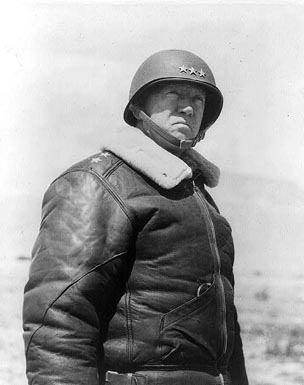
The big camp buzzed with a tension. For hundreds of eager rookies, newly arrived from the states, it was a great day in their lives. This day marked their first taste of the "real thing". Now they were not merely puppets in brown uniforms. They were not going through the motions of soldiering with three thousand miles of ocean between them and English soil. They were actually in the heart of England itself. They were waiting for the arrival of that legendary figure, Lieutenant General George S. Patton, Jr. Old "Blood and Guts" himself, about whom many a colorful chapter would be written for the school boys of tomorrow. Patton of the brisk, purposeful stride. Patton of the harsh, compelling voice, the lurid vocabulary, the grim and indomitable spirit that carried him and his Army to glory in Africa and Sicily. They called him "America's Fightingest General". He was no desk commando. He was the man who was sent for when the going got rough and a fighter was needed. He was the most hated and feared American of all on the part of the German Army.
Patton was coming and the stage was being set. He would address a move which might have a far reaching effect on the global war that, at the moment, was a TOP-SECRET in the files in Washington, D.C.
The men saw the camp turn out "en masse" for the first time and in full uniform, too. Today their marching was not lackadaisical. It was serious and the men felt the difference. From the lieutenants in charge of the companies on down in rank they felt the difference.
In long columns they marched down the hill from the barracks. They counted cadence while marching. They turned off to the left, up the rise and so on down into the roped off field where the General was to speak. Gold braid and stripes were everywhere. Soon, company by company, the hillside was a solid mass of brown. It was a beautiful fresh English morning. The tall trees lined the road and swayed gently in the breeze. Across the field, a British farmer calmly tilled his soil. High upon a nearby hill a group of British soldiers huddled together, waiting for the coming of the General. Military Police were everywhere wearing their white leggings, belts, and helmets. They were brisk and grim. The twittering of the birds in the trees could be heard above the dull murmur of the crowd and soft, white clouds floated lazily overhead as the men settled themselves and lit cigarettes.
On the special platform near the speakers stand, Colonels and Majors were a dime a dozen. Behind the platform stood General Patton's "Guard of Honor"; all specially chosen men. At their right was a band playing rousing marches while the crowd waited and on the platform a nervous sergeant repeatedly tested the loudspeaker. The moment grew near and the necks began to crane to view the tiny winding road that led to Stourport-on-Severn. A captain stepped to the microphone. "When the General arrives," he said sonorously, "the band will play the Generals March and you will all stand at attention."
By now the rumor had gotten around that Lieutenant General Simpson, Commanding General of the Fourth Army, was to be with General Patton. The men stirred expectantly. Two of the big boys in one day!
At last, the long black car, shining resplendently in the bright sun, roared up the road, preceded by a jeep full of Military Police. A dead hush fell over the hillside. There he was! Impeccably dressed. With knee high, brown, gleaming boots, shiny helmet, and his Colt .45 Peacemaker swinging in its holster on his right side.
Patton strode down the incline and then straight to the stiff backed "Guard of Honor". He looked them up and down. He peered intently into their faces and surveyed their backs. He moved through the ranks of the statuesque band like an avenging wraith and, apparently satisfied, mounted the platform with Lieutenant General Simpson and Major General Cook, the Corps Commander, at his side.
Major General Cook then introduced Lieutenant General Simpson, whose Army was still in America, preparing for their part in the war.
"We are here", said General Simpson, "to listen to the words of a great man. A man who will lead you all into whatever you may face with heroism, ability, and foresight. A man who has proven himself amid shot and shell. My greatest hope is that some day soon, I will have my own Army fighting with his, side by side."
General Patton arose and strode swiftly to the microphone. The men snapped to their feet and stood silently. Patton surveyed the sea of brown with a grim look. "Be seated", he said. The words were not a request, but a command. The General's voice rose high and clear.
"Men, this stuff that some sources sling around about America wanting out of this war, not wanting to fight, is a crock of bullshit. Americans love to fight, traditionally. All real Americans love the sting and clash of battle. You are here today for three reasons. First, because you are here to defend your homes and your loved ones. Second, you are here for your own self respect, because you would not want to be anywhere else. Third, you are here because you are real men and all real men like to fight. When you, here, everyone of you, were kids, you all admired the champion marble player, the fastest runner, the toughest boxer, the big league ball players, and the All-American football players. Americans love a winner. Americans will not tolerate a loser. Americans despise cowards. Americans play to win all of the time. I wouldn't give a hoot in hell for a man who lost and laughed. That's why Americans have never lost nor will ever lose a war; for the very idea of losing is hateful to an American."
The General paused and looked over the crowd. "You are not all going to die," he said slowly. "Only two percent of you right here today would die in a major battle. Death must not be feared. Death, in time, comes to all men. Yes, every man is scared in his first battle. If he says he's not, he's a liar. Some men are cowards but they fight the same as the brave men or they get the hell slammed out of them watching men fight who are just as scared as they are. The real hero is the man who fights even though he is scared. Some men get over their fright in a minute under fire. For some, it takes an hour. For some, it takes days. But a real man will never let his fear of death overpower his honor, his sense of duty to his country, and his innate manhood. Battle is the most magnificent competition in which a human being can indulge. It brings out all that is best and it removes all that is base. Americans pride themselves on being He Men and they ARE He Men. Remember that the enemy is just as frightened as you are, and probably more so. They are not supermen."
"All through your Army careers, you men have bitched about what you call "chicken shit drilling". That, like everything else in this Army, has a definite purpose. That purpose is alertness. Alertness must be bred into every soldier. I don't give a fuck for a man who's not always on his toes. You men are veterans or you wouldn't be here. You are ready for what's to come. A man must be alert at all times if he expects to stay alive. If you're not alert, sometime, a German son-of-an-asshole-bitch is going to sneak up behind you and beat you to death with a sockful of shit!" The men roared in agreement.
Patton's grim expression did not change. "There are four hundred neatly marked graves somewhere in Sicily", he roared into the microphone, "All because one man went to sleep on the job". He paused and the men grew silent. "But they are German graves, because we caught the bastard asleep before they did". The General clutched the microphone tightly, his jaw out-thrust, and he continued, "An Army is a team. It lives, sleeps, eats, and fights as a team. This individual heroic stuff is pure horse shit. The bilious bastards who write that kind of stuff for the Saturday Evening Post don't know any more about real fighting under fire than they know about fucking!"
The men slapped their legs and rolled in glee. This was Patton as the men had imagined him to be, and in rare form, too. He hadn't let them down. He was all that he was cracked up to be, and more. He had IT!
"We have the finest food, the finest equipment, the best spirit, and the best men in the world", Patton bellowed. He lowered his head and shook it pensively. Suddenly he snapped erect, faced the men belligerently and thundered, "Why, by God, I actually pity those poor sons-of-bitches we're going up against. By God, I do". The men clapped and howled delightedly. There would be many a barracks tale about the "Old Man's" choice phrases. They would become part and parcel of Third Army's history and they would become the bible of their slang.
"My men don't surrender", Patton continued, "I don't want to hear of any soldier under my command being captured unless he has been hit. Even if you are hit, you can still fight back. That's not just bull shit either. The kind of man that I want in my command is just like the lieutenant in Libya, who, with a Luger against his chest, jerked off his helmet, swept the gun aside with one hand, and busted the hell out of the Kraut with his helmet. Then he jumped on the gun and went out and killed another German before they knew what the hell was coming off. And, all of that time, this man had a bullet through a lung. There was a real man!"
Patton stopped and the crowd waited. He continued more quietly, "All of the real heroes are not storybook combat fighters, either. Every single man in this Army plays a vital role. Don't ever let up. Don't ever think that your job is unimportant. Every man has a job to do and he must do it. Every man is a vital link in the great chain. What if every truck driver suddenly decided that he didn't like the whine of those shells overhead, turned yellow, and jumped headlong into a ditch? The cowardly bastard could say, "Hell, they won't miss me, just one man in thousands". But, what if every man thought that way? Where in the hell would we be now? What would our country, our loved ones, our homes, even the world, be like? No, Goddamnit, Americans don't think like that. Every man does his job. Every man serves the whole. Every department, every unit, is important in the vast scheme of this war. The ordnance men are needed to supply the guns and machinery of war to keep us rolling. The Quartermaster is needed to bring up food and clothes because where we are going there isn't a hell of a lot to steal. Every last man on K.P. has a job to do, even the one who heats our water to keep us from getting the 'G.I. Shits'."
Patton paused, took a deep breath, and continued, "Each man must not think only of himself, but also of his buddy fighting beside him. We don't want yellow cowards in this Army. They should be killed off like rats. If not, they will go home after this war and breed more cowards. The brave men will breed more brave men. Kill off the Goddamned cowards and we will have a nation of brave men. One of the bravest men that I ever saw was a fellow on top of a telegraph pole in the midst of a furious fire fight in Tunisia. I stopped and asked what the hell he was doing up there at a time like that. He answered, "Fixing the wire, Sir". I asked, "Isn't that a little unhealthy right about now?" He answered, "Yes Sir, but the Goddamned wire has to be fixed". I asked, "Don't those planes strafing the road bother you?" And he answered, "No, Sir, but you sure as hell do!" Now, there was a real man. A real soldier. There was a man who devoted all he had to his duty, no matter how seemingly insignificant his duty might appear at the time, no matter how great the odds. And you should have seen those trucks on the road to Tunisia. Those drivers were magnificent. All day and all night they rolled over those son-of-a-bitching roads, never stopping, never faltering from their course, with shells bursting all around them all of the time. We got through on good old American guts. Many of those men drove for over forty consecutive hours. These men weren't combat men, but they were soldiers with a job to do. They did it, and in one hell of a way they did it. They were part of a team. Without team effort, without them, the fight would have been lost. All of the links in the chain pulled together and the chain became unbreakable."
The General paused and stared challengingly over the silent ocean of men. One could have heard a pin drop anywhere on that vast hillside. The only sound was the stirring of the breeze in the leaves of the bordering trees and the busy chirping of the birds in the branches of the trees at the General's left.
"Don't forget," Patton barked, "you men don't know that I'm here. No mention of that fact is to be made in any letters. The world is not supposed to know what the hell happened to me. I'm not supposed to be commanding this Army. I'm not even supposed to be here in England. Let the first bastards to find out be the Goddamned Germans. Some day I want to see them raise up on their piss-soaked hind legs and howl, 'Jesus Christ, it's the Goddamned Third Army again and that son-of-a-fucking-bitch Patton'."
"We want to get the hell over there", Patton continued, "The quicker we clean up this Goddamned mess, the quicker we can take a little jaunt against the purple pissing Japs and clean out their nest, too. Before the Goddamned Marines get all of the credit."
The men roared approval and cheered delightedly. This statement had real significance behind it. Much more than met the eye and the men instinctively sensed the fact. They knew that they themselves were going to play a very great part in the making of world history. They were being told as much right now. Deep sincerity and seriousness lay behind the General's colorful words. The men knew and understood it. They loved the way he put it, too, as only he could.
Patton continued quietly, "Sure, we want to go home. We want this war over with. The quickest way to get it over with is to go get the bastards who started it. The quicker they are whipped, the quicker we can go home. The shortest way home is through Berlin and Tokyo. And when we get to Berlin", he yelled, "I am personally going to shoot that paper hanging son-of-a-bitch Hitler. Just like I'd shoot a snake!"
"When a man is lying in a shell hole, if he just stays there all day, a German will get to him eventually. The hell with that idea. The hell with taking it. My men don't dig foxholes. I don't want them to. Foxholes only slow up an offensive. Keep moving. And don't give the enemy time to dig one either. We'll win this war, but we'll win it only by fighting and by showing the Germans that we've got more guts than they have; or ever will have. We're not going to just shoot the sons-of-bitches, we're going to rip out their living Goddamned guts and use them to grease the treads of our tanks. We're going to murder those lousy Hun cocksuckers by the bushel-fucking-basket. War is a bloody, killing business. You've got to spill their blood, or they will spill yours. Rip them up the belly. Shoot them in the guts. When shells are hitting all around you and you wipe the dirt off your face and realize that instead of dirt it's the blood and guts of what once was your best friend beside you, you'll know what to do!"
"I don't want to get any messages saying, "I am holding my position." We are not holding a Goddamned thing. Let the Germans do that. We are advancing constantly and we are not interested in holding onto anything, except the enemy's balls. We are going to twist his balls and kick the living shit out of him all of the time. Our basic plan of operation is to advance and to keep on advancing regardless of whether we have to go over, under, or through the enemy. We are going to go through him like crap through a goose; like shit through a tin horn!"
"From time to time there will be some complaints that we are pushing our people too hard. I don't give a good Goddamn about such complaints. I believe in the old and sound rule that an ounce of sweat will save a gallon of blood. The harder WE push, the more Germans we will kill. The more Germans we kill, the fewer of our men will be killed. Pushing means fewer casualties. I want you all to remember that."
The General paused. His eagle like eyes swept over the hillside. He said with pride, "There is one great thing that you men will all be able to say after this war is over and you are home once again. You may be thankful that twenty years from now when you are sitting by the fireplace with your grandson on your knee and he asks you what you did in the great World War II, you WON'T have to cough, shift him to the other knee and say, "Well, your Granddaddy shoveled shit in Louisiana." No, Sir, you can look him straight in the eye and say, "Son, your Granddaddy rode with the Great Third Army and a Son-of-a-Goddamned-Bitch named Georgie Patton!"
Friday, November 23, 2007
Quote of the Day

"Civilization has affected us. We abhor personal encounter. Many a man will risk his life, with an easy mind, in a burning house who would recoil from having his nose punched. We have been taught restraint from our emotions, to look upon anger as low, until many of us have never experienced the God sent ecstasy of unbridled wrath. We have never felt our eyes screw up, our temples throb, and have never had the red mist gather in our sight. But, we expect that a man shall, in an instant, in the twinkling of an eye, divest himself of all restraint, of all caution, and hurl himself upon the enemy, a frenzied beast, lusting to probe his enemy's guts with three feet of steel or to shatter his brain with a bullet. Gentlemen, it cannot be done without mental practice. Therefore, you must school yourselves to savagery. You must imagine how it will feel when your sword hilt crashes into the breastbone of your enemy. You must picture the wild exaltation of the mounted charge when the lips are drawn back into a snarl and the voice cracks with a passion. At one time, you must be both a wise man and a fool." - General George Smith Patton Jr.
Subscribe to:
Posts (Atom)